Physical Production. AI-Expanded Cinema.
Story Studio AI is building a hybrid motion-picture production company combining traditional physical filmmaking with advanced artificial-intelligence production. The foundation remains filmmaking as audiences and filmmakers know it.
Real actors perform together. A real director directs them. A cinematographer photographs those performances with professional cinema cameras and lighting. Production designers, costume designers, makeup artists, stunt professionals, sound crews and technicians remain part of the process.
But instead of taking that entire production around the world, Story Studio AI intends to bring much of the world to the production. Actors may perform on controlled stages in Germany while the finished film places them convincingly in New York, Paris, Stockholm, Marrakech, Monte Carlo, a desert highway or an environment that does not exist anywhere on Earth.
AI becomes an extension of physical production.
Shoot the performance. Build the world.
A screenplay may require only a few principal actors. But the world surrounding those actors can turn a modest production into a $20 million, $40 million or substantially larger undertaking.
International travel. Hotels. Location permits. Company moves. Vehicle fleets. Road closures. Large numbers of extras. Set construction. Weather delays. Second units. Stunts. Helicopters. Crowds. Large action sequences. Extensive visual effects.
Every new location can introduce another layer of cost and logistical risk. Independent filmmakers frequently respond by reducing the ambition of the screenplay.
Keep the ambition. Change the production method.
Story Studio AI intends to establish a controlled physical production base, initially in Germany or Europe. Principal actors and essential physical elements are photographed there. The production then works with a specialized AI technology partner to transform and extend those photographed performances into finished cinematic environments and sequences.
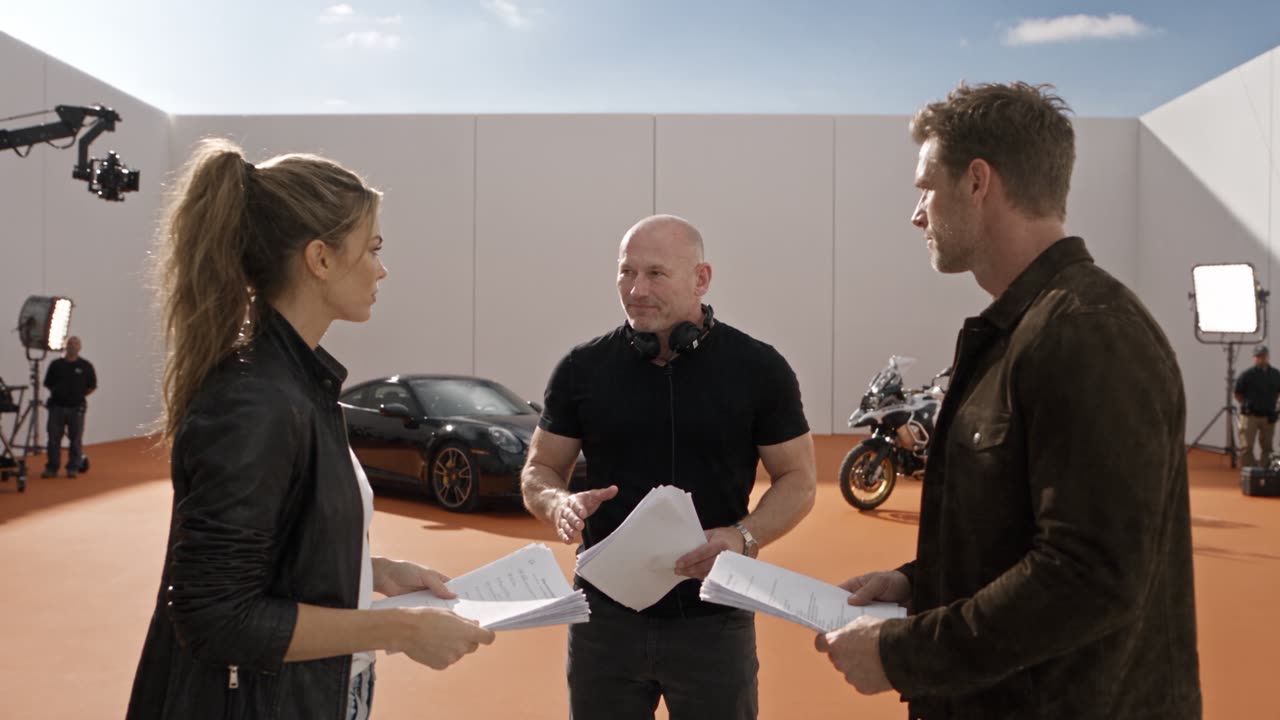
Two actors perform a dramatic scene on a controlled stage. The director controls the performance. The cinematographer controls the camera, lenses and lighting. The production records everything required to preserve a genuine human performance.
That stage becomes a Paris street. The next scene becomes Tokyo. The next becomes New York. A practical vehicle can become part of a major chase. A controlled stunt can become part of a substantially larger action sequence. Hundreds of background characters can populate an environment without transporting hundreds of people around the world.
Physical photography, AI-generated elements, conventional VFX, compositing, editing, sound design, music and color grading are combined into the finished motion picture.
The audience should not be thinking about the technology. They should simply be watching a movie.
Story Studio AI has access to a potential first feature screenplay whose conventional production requirements could place it approximately in the $20 million production class. Our initial objective is to investigate whether the same creative scope could be achieved using the Story Studio AI production system for approximately $3–4 million.
This is not a promise that every Story Studio AI production will cost 80% less. It is the hypothesis our first feature is designed to test. Different productions will produce different savings.
A dialogue-driven drama may gain relatively little from the system. A movie containing numerous international locations, vehicles, crowds and major action sequences may gain substantially more. Story Studio AI therefore intends to concentrate initially on projects where the production model creates the greatest economic advantage.
Our first feature will be designed as both a commercial motion picture and a validation of the Story Studio AI production system. Before committing the complete production budget, representative sequences will be created.
Only after those tests establish an acceptable creative and economic result should the full feature move into production.
Prove the pipeline before scaling the pipeline.
The business is designed around three primary components.
Story Studio AI develops and packages projects, controls the overall production methodology, coordinates the partners, develops intellectual property and builds the commercial production pipeline. Story Studio AI becomes the bridge between traditional filmmaking and emerging production technology.
We are seeking an established German or European production company or studio capable of providing some combination of: soundstages, production crew, cameras, lighting, grip, sound, production services, construction, wardrobe and makeup facilities, production management and physical infrastructure. Rather than competing with conventional production companies, Story Studio AI can potentially give an existing production facility a new category of work.
We are seeking a leading AI filmmaking or generative-video company capable of becoming a serious production partner rather than simply a software vendor. Its technology may support environment creation, location transformation, character continuity, crowds, vehicles, action expansion, set extension, previsualization, image-to-video production, compositing workflows and other emerging generative filmmaking capabilities. The first feature becomes an opportunity to demonstrate that this technology can function inside a professional feature-film production pipeline.
Story Studio AI can provide actors, directors, cinematographers, production crews and feature-film material against which the technology can be developed and demonstrated.
The partnership can potentially create:
Instead of demonstrating AI filmmaking through isolated technology clips, the partner helps demonstrate it through a completed commercial motion picture.
Story Studio AI is not trying to eliminate the stage. A production facility that previously rented a stage for individual projects could potentially become part of a repeatable production pipeline.
The partner can generate revenue through:
Instead of sending productions away from the stage to spend money around the world, more of that production expenditure can remain concentrated at the production center.
Film investment always involves risk. Story Studio AI cannot eliminate that risk. But reducing the amount of capital required to create comparable cinematic scale can fundamentally change the financial equation.
A conventional $20 million movie must recover a substantially larger investment before generating returns. A $3–4 million production begins from a very different capital position. This potentially:
However, lower production cost does not guarantee profitability. Commercial success will still depend on the screenplay, cast, execution, distribution, marketing and audience demand.
Once the production system has been validated, the same capabilities can potentially be offered to other filmmakers. A producer may arrive with a screenplay requiring $15 million under a conventional production model but only have access to substantially less capital — Story Studio AI may be able to help redesign that production around the hybrid model.
That creates a second business — Story Studio AI can earn revenue even when it does not own the underlying film.
The objective is not: make one inexpensive movie. The objective is: build a production company that becomes more valuable every time it makes one.
Every completed production creates knowledge.
Camera configurations. Lighting methodologies. Actor capture procedures. AI workflows. Prompting systems. Continuity processes. Digital environments. Post-production techniques. Vendor relationships. Cost data. Scheduling data. Quality-control procedures.
Subject to contractual and intellectual-property restrictions, appropriate assets and processes can be reused or adapted. The second production should therefore not begin from zero. Neither should the third.
One film becomes a system. The system becomes a slate. The slate becomes a studio.
Story Studio AI does not need to give every participant permanent ownership in the parent company. This distinction is extremely important.
Different contributions can receive different compensation. A physical production partner might receive production fees plus negotiated project participation. An AI partner might receive licensing fees, service fees, preferred-provider status and negotiated project participation. An investor might receive recoupment priority and negotiated profit participation. A strategic founding investor might potentially receive equity in Story Studio AI itself. Talent may receive salary plus negotiated participation.
Individual films can be held in separate production entities so that investment and risk can be structured on a project-by-project basis. The exact structure will be developed with experienced entertainment, corporate and tax counsel before investment is accepted or ownership is distributed.
Partnership does not automatically mean giving away the company.
AI technology partner. Physical production partner. Production leadership. Legal structure. Initial financing.
Produce several demanding proof-of-concept sequences. Establish actual production costs. Measure production time. Determine technical limitations. Establish quality standards.
Finalize screenplay, budget, schedule, cast, director, distribution strategy and financing.
Physical principal photography. AI-expanded production. Post-production. Final delivery.
Sell and distribute the first film. Launch the next projects. Offer production services to outside filmmakers. Develop strategic partnerships. Build the Story Studio AI slate.
Before announcing a final investment target, Story Studio AI will complete detailed budgeting across company formation, development, technical proof of concept, physical and AI production, post-production, legal, distribution preparation, marketing and contingency.
Company formation and legal work. Development. Technical proof of concept. Stage and infrastructure. Cast. Crew. Equipment. Physical production. AI production. VFX and compositing. Editorial. Music. Sound. Insurance. Legal. Deliverables. Distribution preparation. Marketing. Contingency.
The current working hypothesis for the first feature is approximately $3–4 million, but the final financing requirement should only be established after technical validation and professional line-item budgeting. Story Studio AI may also require separate development and operating capital before the feature enters production.
These numbers will be established transparently rather than reverse-engineered to support a marketing claim.
Story Studio AI therefore intends to control risk through staged production.
If the audience can see the technology instead of the movie, the shot isn't finished.
A validated system could eventually support multiple simultaneous productions, international partnerships and specialized production units.
Directors could bring ambitious projects that conventional independent financing cannot support. Producers could visualize films before committing full production capital. AI companies could test new filmmaking technologies against professional production requirements. Existing studios could transform unused or underutilized stages into hybrid filmmaking facilities.
And Story Studio AI could develop a growing portfolio of intellectual property while generating service revenue from productions it does not own.
We are therefore not building an AI movie generator. We are building a motion-picture production company for the next generation of filmmaking.
Story Studio AI is currently seeking conversations with:
We are particularly interested in organizations that understand the opportunity is larger than one production. The first film demonstrates the model. The subsequent slate scales it. Third-party productions monetize it. And every successful production improves the system.
We are now assembling the partners who want to build it with us.
Discuss a Partnership